
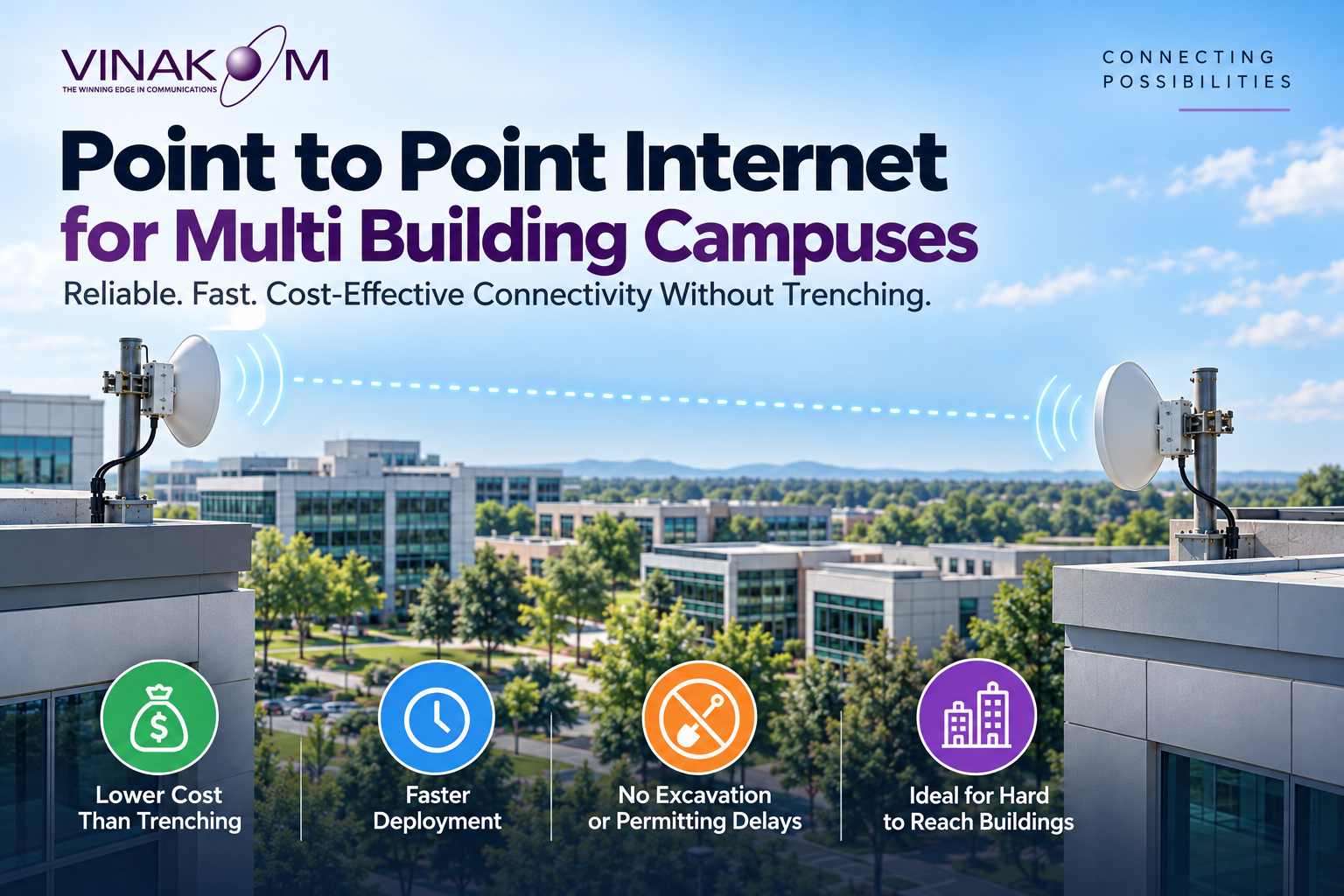
If two or more of your buildings need to share one network and running cable between them is not practical, a point to point internet link is usually the fastest way to solve it. It uses two radios in direct line of sight to move data through the air instead of through the ground, and for many campuses it costs a fraction of trenching new fiber. At Vinakom, this is one of the connectivity options we help multi building campuses, offices, and facilities evaluate when a standard fiber run does not fit the site.
That said, it is not the right call for every situation. Distance, obstructions, weather patterns, and how much bandwidth your buildings actually push back and forth all change the math. Here is how to think it through.
What a point to point wireless bridge actually is
A point to point wireless bridge, sometimes called a wireless ethernet bridge, is a pair of radios mounted on two structures that face each other directly. One side plugs into your main network switch, the other plugs into the switch at the remote building, and the link behaves like a long ethernet cable stretched through open air. There is no third party carrier in the middle and no shared tower, which is part of why these links can be so stable when they are engineered correctly.
Most modern bridges built for business and campus use run on unlicensed spectrum, commonly the 5 GHz band or the 60 GHz band, and can move traffic from a few hundred megabits per second up to multiple gigabits depending on the equipment and distance involved.
Why campuses reach for wireless instead of cable
The honest answer is usually cost and timeline, not technology preference. Trenching underground conduit for fiber is the most expensive way to connect two buildings. Industry deployment data collected across US fiber builds puts the median cost of installing new conduit and pulling cable through it at roughly eighteen dollars and fifty cents per foot, and direct trenching alone at around nineteen dollars per foot, making it the priciest common construction method compared with aerial builds, which run closer to seven dollars per foot for strand and lash installations.
On a campus with parking lots, mature landscaping, underground utilities, or a historic building that cannot be disturbed, those per foot costs add up fast, and that is before you factor in permitting. Getting approval to dig across a road, cross a utility easement, or work near a rail line often means coordinating with more than one authority. Municipal right of way rules, state transportation departments, and utility owners can each add weeks or months before a shovel ever touches the ground, and unresolved property rights or incomplete permit paperwork are common causes of delay.
A point to point wireless link mounted on a rooftop or a pole typically does not carry that same permitting burden, since it is not disturbing ground, roadways, or third party right of way, which is a large part of why campuses use it to bypass the slowest part of a fiber project.
Where a point to point wireless bridge makes the most sense
- Two buildings separated by something you cannot dig through. Parking structures, retention ponds, protected wetlands, and roads that a municipality will not let you cut into are all common reasons campuses choose wireless over cable. If digging is off the table or prohibitively expensive, a rooftop to rooftop link solves the problem in days instead of months.
- Temporary, modular, or leased buildings. Portable classrooms, modular offices, and buildings you lease rather than own are poor candidates for buried infrastructure you cannot take with you. A wireless bridge can be relocated if the building moves or the lease ends.
- A backup path for an existing fiber run. Even campuses with fiber already in the ground often add a wireless bridge as a redundant path. If a backhoe cuts the buried line or a conduit floods, network traffic can fail over to the wireless link instead of going dark.
- Fast turnaround projects. New buildings, acquisitions, or seasonal facilities that need connectivity in weeks rather than months are a strong fit. A wireless bridge can typically be surveyed, mounted, and aligned much faster than a permitted underground build.
Is point to point internet as reliable as fiber?
It can be, but reliability depends heavily on how the link is engineered. Licensed microwave links, which operate on FCC assigned frequencies in the higher gigahertz bands, are built to deliver predictable, interference free performance and are commonly rated for very high uptime, which is why they show up in mission critical campus and telecommunications networks. The tradeoff is cost, since a license carries fees and a longer setup process.
Unlicensed wireless bridges, the more common choice for business campuses, share spectrum with other nearby devices, so a poorly planned installation can suffer from interference or performance that degrades over time as more equipment shows up in the same band. A properly surveyed link with a clean line of sight, correctly sized antennas, and enough distance from competing signals can still perform very reliably, but it takes real engineering, not just mounting two boxes and pointing them at each other. This is the part of the process where working with a managed provider like Vinakom tends to matter most, since the site survey and equipment sizing are what separate a stable link from a flaky one.
Weather is the other variable worth planning for. Links running on higher frequency bands, including 60 GHz, are more sensitive to heavy rain and fog over longer distances, so equipment selection and link distance both matter more as frequency increases.
Licensed vs Unlicensed Spectrum: What the FCC Rules Cover
The Federal Communications Commission has expanded unlicensed spectrum available for point to point use several times specifically to support broadband deployment to buildings that are hard to reach with cable. In 2013 the Commission modified its rules for the 60 GHz band to allow higher power limits for outdoor point to point systems using high gain antennas, a change made explicitly to extend how far these links could reach and to help bring broadband to office buildings and other commercial facilities. Separate rules for the 5 GHz U-NII bands permit point to point installations to use larger, more directional antennas without a reduction in allowed power, which is part of why 5 GHz remains a common choice for campus bridges today.
None of this requires you to become a spectrum expert. It simply means unlicensed point to point equipment is not an unregulated gray area. It operates inside specific FCC power and frequency rules designed with exactly this kind of building to building connection in mind.
The bottom line
Point to point internet is not a replacement for fiber everywhere on your campus. It is the right tool for the specific buildings where trenching is too slow, too expensive, or simply not possible. If you are weighing options for a multi building site, Vinakom can walk your locations, check line of sight, and tell you honestly whether wireless, fiber, or a mix of both makes the most sense.
Frequently asked questions
How far can a point to point wireless bridge reach?
Business grade unlicensed bridges commonly cover anywhere from a few hundred feet to several miles depending on the frequency, antenna size, and how clear the line of sight is. Licensed microwave links can extend considerably further.
Do I need an FCC license to install a wireless ethernet bridge?
Not for equipment operating in unlicensed bands such as 5 GHz or 60 GHz, as long as it stays within FCC power limits. Licensed microwave links do require an FCC license and a coordinated frequency assignment.
Is a wireless bridge as fast as running fiber?
Modern point to point bridges can deliver gigabit or multi gigabit speeds over shorter distances, which is enough for most campus applications. For extremely high, sustained bandwidth needs over long distances, physical fiber still has an edge.
What happens to a wireless bridge during bad weather?
Lower frequency unlicensed bands such as 5 GHz are relatively resistant to rain. Higher frequency links, including 60 GHz and some licensed microwave bands, are more sensitive to heavy precipitation over longer spans, so distance and frequency should be matched carefully during planning.
Can a wireless bridge replace fiber entirely on a campus?
It can for many building pairs, but most well designed campus networks use wireless bridges alongside fiber rather than as a complete replacement, reserving wireless for hard to reach buildings, temporary structures, or backup paths. Our team at Vinakom typically recommends a mix, using wireless where it solves a real constraint and fiber everywhere else.